




[특집] 제2회 한국전 참전용사에게 바치는 청소년에세이대회 열려
페이지 정보
본문
풀러톤 참전용사기념공원에서
글로벌힐링아트테라피 주관으로
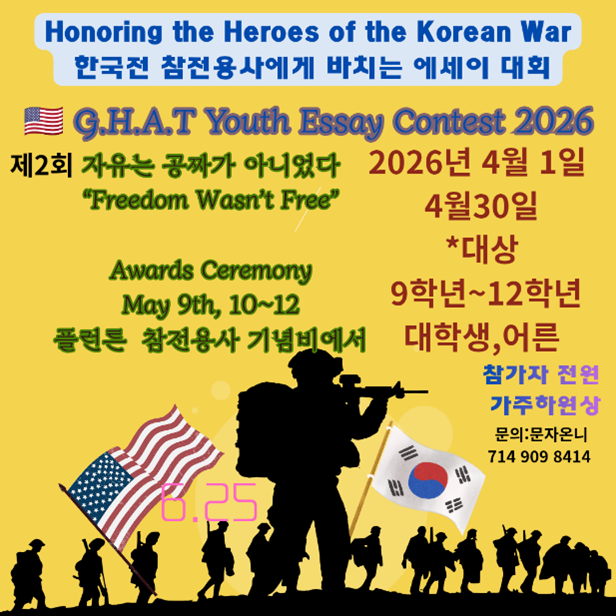
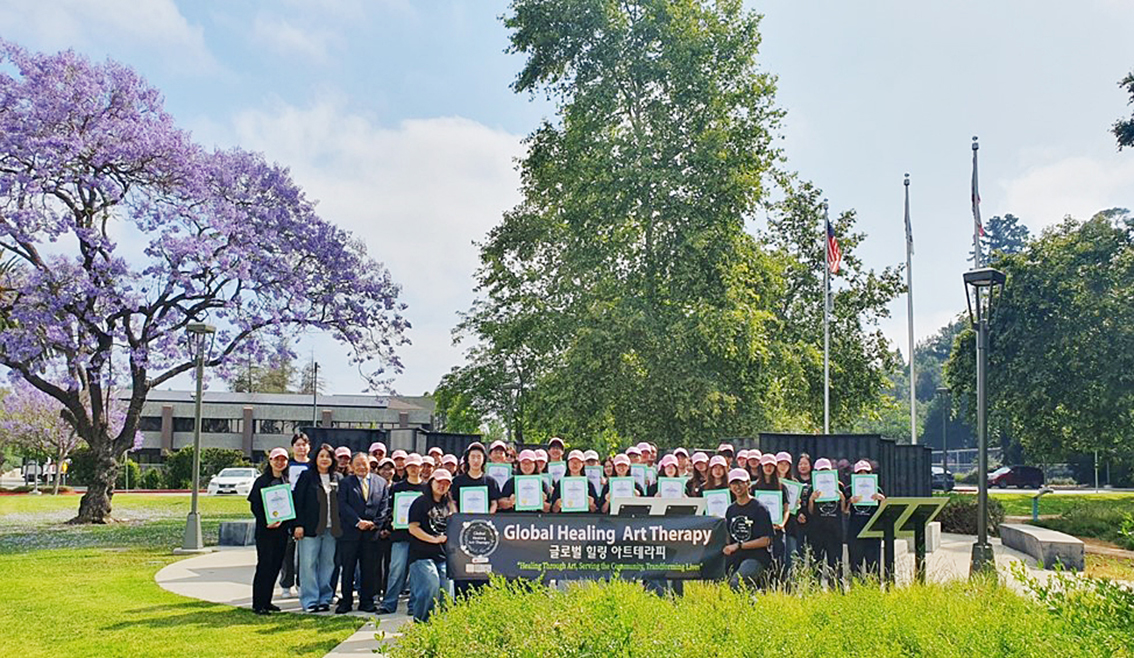
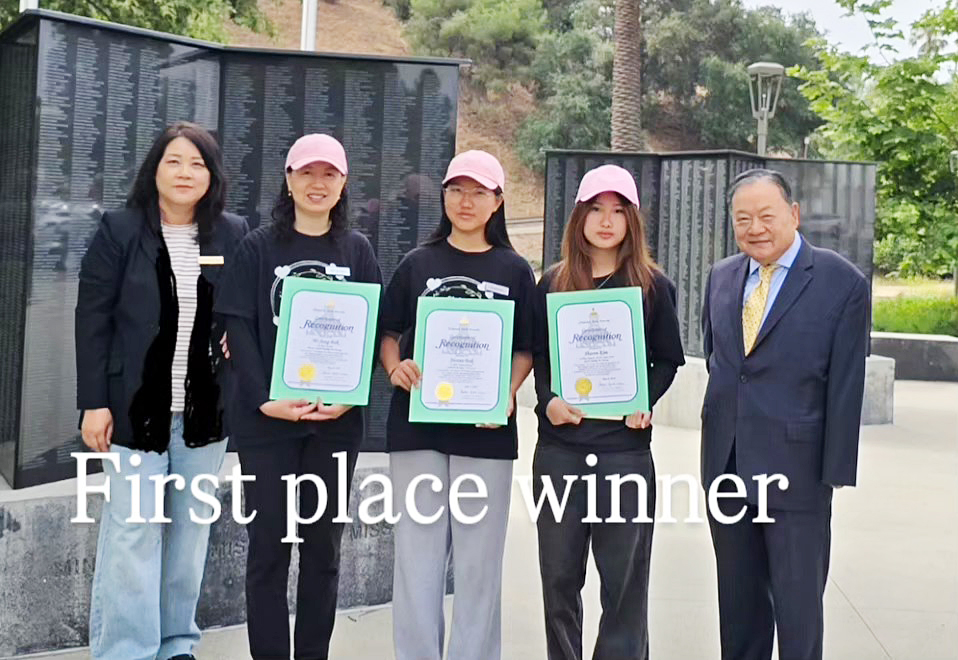
올해로 두번째 열린 청소년 에세이 대회가 성공적으로 마무리됐다. 글로벌힐링아트(대표 김은미)는 한인 청소년들이 한국전참전용사기념비가 있는 풀러톤에서 제2회 G.H.A.T 청소년 에세이 대회 시상식이 뜻깊게 열렸다고 밝혔다.
글로벌 힐링 아트 테라피(Global Healing Art Therapy, GHAT)는 예술을 통해 개인의 감정을 회복하고 지역사회에 희망을 전하는 비영리 단체로 예술, 음악, 캘리그래피 등 다양한 창의적 매체를 활용하여 심리적 안정과 치유를 돕는 프로그램을 운영 중이다.
전문가를 위한 임상 치료가 아닌, 예술을 기반으로 한 비임상적 커뮤니티 지원 프로그램을 제공하며 사회 봉사로 노숙인(홈리스)을 대상으로 한 아트 봉사 및 수제 아트 키트 제공, 지역사회 캘리그래피 버스킹 등을 통해 따뜻한 메시지를 나누기도 한다.
GHATS는 '자녀의 미래를 세우는 시편 기도회(자.미.세)'와 같은 모임을 통해 부모의 마음 회복과 자녀를 위한 영성 활동을 결합한 프로그램을 진행하는데 리버데일(Riverdale) 지역에 Global Healing Creative Arts Therapy Studio를 운영하며, 워크숍이나 그룹 세션을 위한 공간 대여 서비스도 제공한다.
글로벌 힐링 아트는 미국 연방정부에 등록된 501(c)(3) 비영리단체로, 지역사회 연결을 증진하는 것을 목표로 활동중이다.
김은미 대표는 공식 웹싸이트에서 “우리 단체는 청소년들이 예술적 봉사활동과 창의적 프로젝트를 통해 자신의 감정을 건강하게 표현하고, 자신감과 공감 능력을 키울 수 있도록 돕고 있다”면서 커뮤니티 센터, 문화기관 등과 협력하여 청소년들이 사회적 책임감과 리더십을 경험하며 지역사회에 긍정적인 영향을 미칠 수 있는 다양한 예술 기반 봉사 프로그램을 제공하고 저희는 예술과 나눔을 통해 사람과 사람을 연결하고, 봉사를 통해 정신적웰빙과 사회적 회복력을 키워가는 따뜻한 공동체를 만들어 가고 있다”고 강조했다.
이날 시상식 행사는 "California Art University Student Ensemble"의 웅장한 오케스트라 연주로 시작됐는데 참전용사 기념비 앞에 울려 퍼진 미국 국가와 애국가는 참전용사분들의 희생을 기리는 우리의 마음을 더욱 경건하게 만들어 주었다고 참가자들은 입을 모았다.
총 35명의 참가자가 정성껏 써 내려간 글을 통해 영웅들을 기억하는 소중한 시간이 되었는데 어른부부터 초·중·고등부까지, 각 부문의 수상자 명단은 다음과 같다.
성인부 Mi Jung Bak(Adult 1등), Morgan Kim(Adult 2등)
고등부 1등 Sharon Kim(9학년,Orange County School of the Arts), 2등 *Stella Hahm(10학년 Orange County School of the Arts) *Ashlyn Yi(9학년, Ruben Ayala High School) *Christina Ryu(9학년, Sunny Hills High School), 3등 *Juha Joel Chang(11학년, High School), *Joshua Chung(10학년, Portola High School), *Hajung Woo(11학년, West Ranch High School), *Kyle Hahm(11학년, Sunny Hills High School)
중등부 1등 Jianna Bak(8학년, Cedarlane Academy), 2등 *Siyoon Lee(8학년, Middle School), *Rinnah Bak(7학년, Cedarlane Academy), 3등 *Hayul Bak(8학년, Seoul Academy), *Haeyul Park(8학년, Seoul Academy) *Juhun Hong(7학년, Beatty Jr High)
초등부 1등 Gabriella Lee(1학년, Frances Meeks Elementary School)
<고등부 1등>
Young Oak Kim: Freedom is not free | Sharon Kim / 9th Grade
Imagine fighting a war where the cold alone could kill you. During the Korean War, soldiers had to deal with temperatures so low that their rifles would freeze and frostbite could set in within minutes.
On top of all that, they still had to fight the enemy. One officer who led his men through these brutal conditions was Young Oak Kim, a Korean American commander whose bravery made him one of the most respected figures of the war.
As a Korean American myself, his story feels personal to me. Young Oak Kim's life proves that freedom is never free. He spent his whole life paying for it, first by pushing through discrimination, then by leading soldiers through one of the hardest wars in American history, and finally by coming home and continuing to fight for his community. Young Oak Kim was born in 1919 in Los Angeles to Korean immigrant parents, which is something I can relate to because my family has a similar background.
Life was really hard for him growing up. His family didn't have much money, and being Asian American back then meant dealing with a lot of racism. Even though he was born in the United States, people treated him like he didn't really belong here.
Historian Ronald Takaki wrote that Asian Americans during this time constantly felt like they were both insiders and outsiders in American society (Takaki 7–8). I think a lot of Korean Americans still feel that way sometimes, even today.
Before he ever put on a uniform, Kim was already fighting just to be treated as an equal. But instead of giving up, he used those experiences to push himself harder.
He even served in World War II with the 442nd Regimental Combat Team, a unit made up mostly of Japanese American soldiers who were fighting for a country that had put their own families in internment camps.
That really says a lot about the kind of person Kim was becoming. When the Korean War started, Kim served as an officer in the U.S. Army's 7th Infantry Division.
This war feels especially close to me because Korea is where my family roots are. The whole peninsula was being torn apart. Families were separated and entire cities were destroyed.
According to the U.S. Army Center of Military History, soldiers had to fight in conditions where the weather and terrain were just as dangerous as the enemy itself.
It was dangerous in every direction. What made Kim stand out was how much he actually cared about his soldiers. Instead of staying somewhere safe and giving orders, he went out to where his men were, even under enemy fire, just to check on them.
The U.S. Army's leadership manual says that good leaders have to stay calm and make smart decisions even when everything is chaotic (U.S. Department of the Army, FM 6-22, Ch. 2). His soldiers trusted him because he was right there with them, going through the same dangerous things they were.
Every single day in Korea was proof that freedom has a price, and Kim and his soldiers were the ones paying it.
After he retired as a colonel, Kim moved back to Los Angeles and became really important in the Korean American community. He worked hard to improve education, create more opportunities, and give Asian Americans a bigger voice in politics at a time when they were being ignored.
Historian Sucheng Chan wrote that Asian American history has always been about fighting to be recognized and included in America (Chan 3–5). That really means something to me because my own parents came here hoping for exactly that. A real chance at a better life.
There is even a center named after him called the Young Oak Kim Center for Korean American Studies, which helps students get better opportunities and become leaders.
When I read about that I thought about how hard my own parents have worked to give me a good education. Kim understood that freedom isn't just about surviving a war.
It also means having access to school and a fair shot at life. Young Oak Kim's story means a lot to me because I see parts of my own family's story in it. He was the child of Korean immigrants, he faced discrimination, and he still chose to serve and fight for this country.
He fought in a war on the same peninsula my family comes from, and when he came home, he didn't stop. He kept working to make life better for his community.
My parents came to America because they wanted a better life and more freedom. Kim's story reminds me that none of that was free. A lot of people worked really hard and gave up a lot for the opportunities I have today, and that's not something I want to take for granted.
Works Cited Chan, Sucheng. Asian Americans: An Interpretive History. Twayne Publishers, 1991. Takaki, Ronald. Strangers from a Different Shore: A History of Asian Americans. Back Bay Books, 1998. U.S. Department of the Army. Field Manual FM 6-22: Army Leadership. 2006. U.S. Army Center of Military History. "Korean War Operational Conditions and Combat Reports." U.S. Army, https://history.army.mil. Korean War historical archives. National Archives and Records Administration (NARA), https://www.archives.gov.
............................................
<성인부 1등>
The Miracle of Life Wrought by the Wings of Conviction – In Honorof Colonel Dean Hesse
| Mi Jung Bak / 성인부
Throughout my long career as a nurse, standing on the front lines where life and death intersect, I have learned that life is a treasure as precious as it is fragile. Today, within this meaningful space of Global Healing Art Therapy—where we strive to mend historical wounds through the power of art—I wish to reflect on the legacy of a true hero: Colonel Dean Hess. He was a man who, as a soldier, exemplified the most sublime height of humanity.
In December 1950, the sub-zero temperatures of the Korean Peninsula were more than just a matter of weather. Amidst the desperate chaos of the January 4th retreat, over 1,000 war orphans were left stranded in Seoul. In that tragic moment, when most would prioritize their own safety, Colonel Hess made a decision that resonates with me far beyond any military achievement. Instead of waiting for formal orders, he chose to prioritize the lives of dying children. Through "Operation Kiddy Car," he mobilized 15 transport planes to evacuate these orphans to the safety of Jeju Island. It was the most radiant bloom of life to emerge from the darkest of battlefields.
His devotion was never a mere temporary relief effort. He poured his soul into the "Bout One" project, laying the foundation for the Republic of Korea Air Force and personally training Korean pilots. Even after the war, he donated the entire proceeds of his autobiography to build orphanages in Korea. The "Hope Village" he established in Jeju became a cradle of healing, mending the emotional scars of the conflict and planting seeds of dreams back into the hearts of children.
As a mother raising two daughters in Los Angeles, I have always emphasized to them that the peaceful lives they enjoy today are not a given. Just as the children Colonel Hess saved grew to become the pillars of modern Korea, his motto, "I Believe I Fly" (Shin-Nyeom-Ui-Jo-In), has become a guiding compass for my daughters, teaching them the value of devotion to others.
The freedom we enjoy today is the most valuable legacy, bought by the blood and sweat of our veterans. I now deeply understand that what you protected so fervently was not just territory, but the innocent laughter and future of our children. I will carry your noble sacrifice in my heart forever and pledge to live a life that sows seeds of peace. To Colonel Dean Hess and all the veterans who served: I offer you my eternal respect and deepest gratitude.


- 이전글[발행인의 시선] 사람과사회 사이에서(1) “분열보다 연대가 필요한 시대” 26.06.09
- 다음글가정의 달은 왜 5월일까? 26.05.12
댓글목록
등록된 댓글이 없습니다.